

The Rouse Simmons, the Christmas Tree Ship
In November 1912 a 44-year-old schooner left Michigan with thousands of Christmas trees for Chicago and was never seen again after she passed Kewaunee. What is known, what is legend, and where the pieces are today.
Added in 2026. A new guide written for this archive from public sources (Wikipedia, the National Register of Historic Places, NOAA, the Wisconsin Historical Society and the attractions themselves). The original Schooner Coast site did not carry this page.
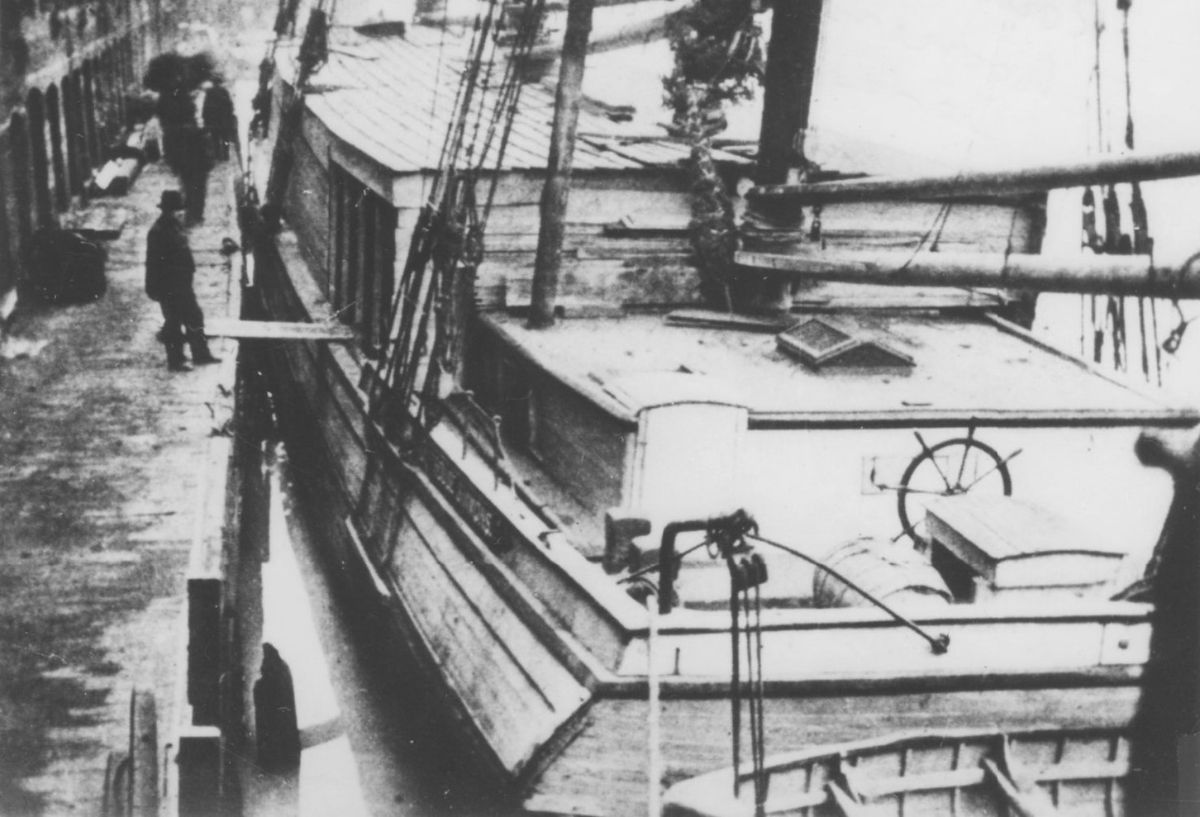
Every town on this coast has a version of the story, and every version starts the same way: a schooner too old for the job, a captain who needed the cash, a November sky the color of slate. Most of that is true. Some of it was added later, which is what happens to a good story told on a waterfront for a hundred years. This guide sticks to what the record supports and says so when it is guessing.
The ship
The Rouse Simmons was launched in Milwaukee on August 15, 1868, by the yard of Allen, McClelland and Company, and named after a Kenosha businessman. She was a three-masted schooner, 123.5 feet long and about 27.6 feet in the beam. The usual lake-schooner design, with a flat bottom and a centerboard you could raise and lower, is the same idea the original Schooner Coast site credits to Manitowoc builders in the 1850s.
Her first serious owner was the Muskegon lumber baron Charles H. Hackley, whose fleet carried lumber from his mills to ports around the lake. For about twenty years she was a workhorse; at her busiest she made nearly weekly runs between Grand Haven and Chicago. After Hackley she changed hands repeatedly, one of the "tramp" schooners that picked up whatever cargo paid. By 1912 she was owned in shares: three-quarters by Mannes J. Bonner of St. James, Michigan, an eighth by Captain Charles Nelson of Chicago, and an eighth by Herman Schuenemann, who had bought in two years earlier.
Captain Santa
Herman Schuenemann and his brother August had been selling Christmas trees in Chicago since the 1890s. August drowned in November 1898 when the small schooner S. Thal sank in a storm near Glencoe, Illinois. Herman kept the business going and found an edge: instead of selling to wholesalers and grocers, he tied up at the Clark Street Bridge and sold straight off the deck, under a tree lashed to the mainmast and strung with electric lights. "Christmas Tree Ship: My Prices are the Lowest" was the slogan. Trees went for 50 cents to a dollar, and Chicago remembered him as "Captain Santa" partly because he gave trees away to families who could not pay.
The last trip
In November 1912 Schuenemann loaded the Rouse Simmons at Thompson Harbor, near Manistique on Michigan's Upper Peninsula, with about 5,500 trees. Bad weather had kept competitors in port and snow had covered the tree lots, so a full ship arriving in Chicago should have sold out fast. He was reportedly short of cash, which is the part of the story everyone agrees made him go.
Two corrections to the usual telling. The often-repeated claim that a storm had already wrecked many ships that month confuses 1912 with the Great Lakes Storm of November 1913; November 1912 had been fairly quiet. And the stories of sailors refusing to board and of a ship known to be unseaworthy are local legend. What is beyond dispute is that she was heavily overloaded, with trees crammed into every available corner, and that a November gale was coming.
On the afternoon of November 23, 1912, a surfman at the Kewaunee Life-Saving Station saw her: low in the water, sails in tatters, flag at half-mast, the signal for distress. It was 2:50 p.m. The station keeper, Nelson Craite, found that his gas tug had gone out earlier in the day, and at 3:10 he telephoned the station to the south at Two Rivers. Keeper George E. Sogge sent the power boat Tuscarora out after her. The crew searched and found nothing. Seventeen people were lost, everyone aboard. The same storm also took the South Shore, the Three Sisters and the Two Brothers.
What came ashore
In December 1912 trees and wreckage were reported washing up at Pentwater, Michigan, across the lake. In 1924 a fishing net brought up Schuenemann's wallet, wrapped in oilskin and still holding business cards, a newspaper clipping and an expense memo. The ship herself stayed lost for 59 years.
In 1971 a Milwaukee diver, Gordon Kent Bellrichard, was looking for a different wreck, the steamer Vernon, lost off Two Rivers in 1887. Local fishermen had told him about a spot where nets kept snagging. His sonar picked something up, and he went down 172 feet to a wooden hull. His light was failing, so he surveyed it largely by touch, and concluded he had found the Rouse Simmons.
A later forensic study suggests the schooner still had steerage and was running for shelter when she sank. Her mizzen mast snapped above the deck. The mainmast lies forward and to port with its base missing, and the foremast lies on top of it, which suggests at least one mast fell out of its step as she went down. Many of the trees are still in her hold.
After the wreck
Barbara Schuenemann and her daughters kept the Christmas tree business going in Chicago for years, still selling from a boat at the dock, though the trees now came down by train. By 1920 nobody shipped Christmas trees across Lake Michigan by schooner any more; railroads, highways and tree farms had made it pointless.
The wreck was listed on the National Register of Historic Places on March 21, 2007, as part of a statewide program documenting Great Lakes shipwreck sites. Since 2021 it has also been inside the Wisconsin Shipwreck Coast National Marine Sanctuary, so it is protected federally as well. The ship's anchor was recovered and now stands at the entrance of the Milwaukee Yacht Club. The wheel and other artifacts are at Rogers Street Fishing Village in Two Rivers.
The story has had a long second life on stage and in print. The Christmas Schooner, a musical by Julie Shannon and John Reeger, follows a fictional ship based on the Rouse Simmons; the original Schooner Coast site advertised performances of it in Two Rivers. The ghost sightings keep coming too, which is about what you would expect of a ship that vanished in a November gale a few weeks before Christmas.
Reading the record yourself
Most of what gets repeated about the Christmas Tree Ship goes back to a short shelf of documents, and anyone writing about her, for a school paper or a talk at a historical society, does better going to them than to the retellings. The National Register nomination for the wreck (reference 07000197) is the most careful modern account of the ship and the site. The Wisconsin Historical Society's Wisconsin Shipwrecks database carries the vessel history. Chicago newspapers followed the loss through December 1912.
Keep track of which source said what. Accounts written in the weeks after the wreck do not agree on every detail, and later books often copy one version without saying so. The fix is old-fashioned: write down where every date and quote came from at the moment you copy it, and put retold passages in your own words with the source named, so your paper does not repeat the same quiet copying. A short guide to writing without plagiarism covers paraphrase and attribution well, and a footnote is also the natural place to say which account you followed where two disagree. The same habit helps if you go on to the related stories on this site, from the original Christmas Tree Ship page to the wider shipwreck guide.
Where to go
- Rogers Street Fishing Village, Two Rivers. The ship's wheel, artifacts and a Christmas Tree Ship exhibit, in the old fishing district along the East Twin River.
- Point Beach State Forest. The wreck lies about six miles offshore. Standing on the beach in late November, with the wind out of the northeast, you get a fair idea of what the Kewaunee surfman saw.
- Kewaunee. The last confirmed sighting was from the life-saving station here; walk out toward the pierhead light and look south.
- Milwaukee Yacht Club. The anchor, if your trip continues south.
Sources: Wikipedia article "Rouse Simmons" (infobox and text, including the NOAA sanctuary report it cites); National Register listing 07000197; Wikipedia article on the Wisconsin Shipwreck Coast National Marine Sanctuary (read November 2026). Where the original Schooner Coast pages differ from these sources, the difference is noted on the restored pages.